


Every millisecond in the bidstream matters for buyers. Processing programmatic advertising at global scale requires enormous computing power, making the infrastructure behind every auction more consequential than most buyers realize. They may never see it directly, but they feel the effects in how supply surfaces, how well their signals are used, and ultimately, the results their campaigns deliver.
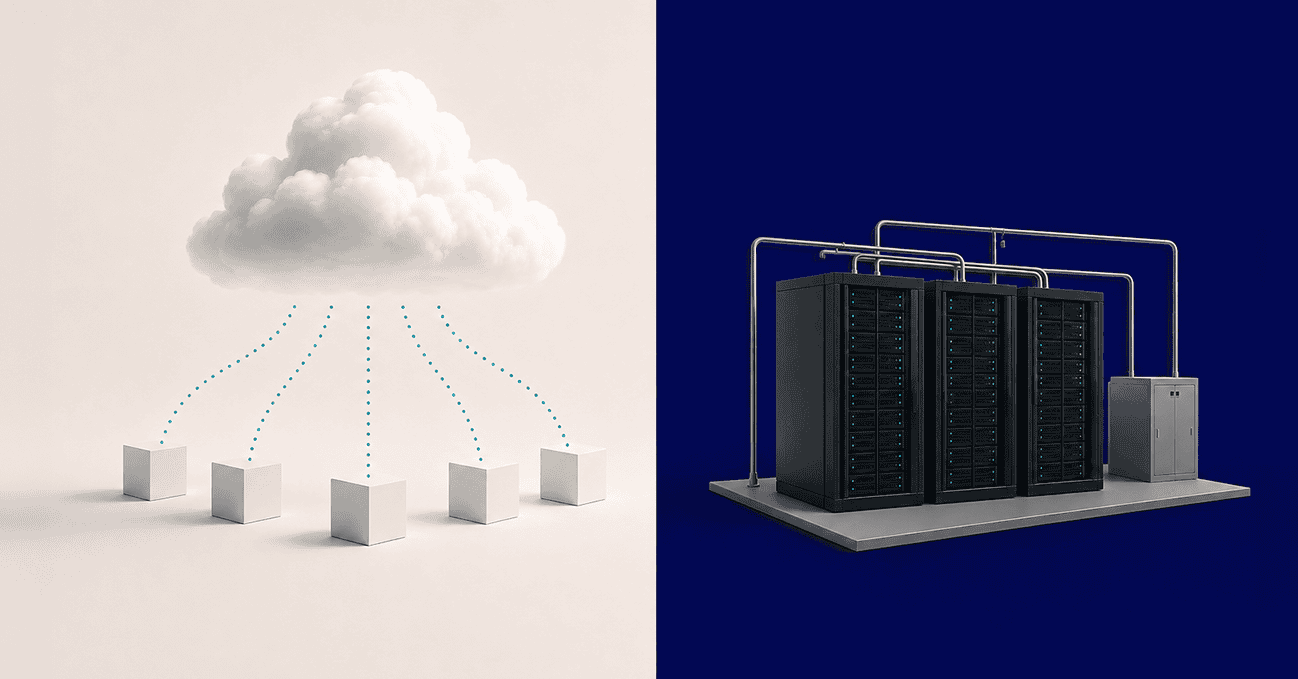
The ‘cloud tax’ is the argument that running an omnichannel SSP on a public cloud adds a hidden infrastructure cost that eventually reaches brands and agencies. But the cloud itself isn’t the issue. What really matters to buyers is the architecture underpinning the exchange and how that design affects latency, or the time it takes to process and respond to a bid request.
What the ‘Cloud Tax’ Argument Gets Wrong
On that front, our approach is straightforward. Aside from the requests we send to bidders, OpenX has never called a service running outside our own cloud-native infrastructure. Every step in the ad request pipeline — whether the logic is ours or our partners’ — runs inside our environment under strict latency SLOs that we monitor continuously.
For buyers, that means custom logic can run within the auction itself, reducing latency and enabling faster, more consistent decisioning at scale. Every engineering hour devoted to provisioning capacity, maintaining systems, or troubleshooting infrastructure (work required if we maintained our own private cloud) is an hour not spent developing new capabilities for buyers. And at OpenX, we know what our priorities are.
Where the Real Cost Sits
Public cloud infrastructure is ideally suited to the demands of real-time bidding, where traffic is variable and every millisecond matters. Capacity can scale as demand changes, compute can stay close to the data it acts on, and redundant-by-design systems recover quickly when something goes wrong. Privately managed systems can perform well, but growth is slower and more hands-on, because new capacity, regions, and redundancy still depend on managing physical infrastructure directly.
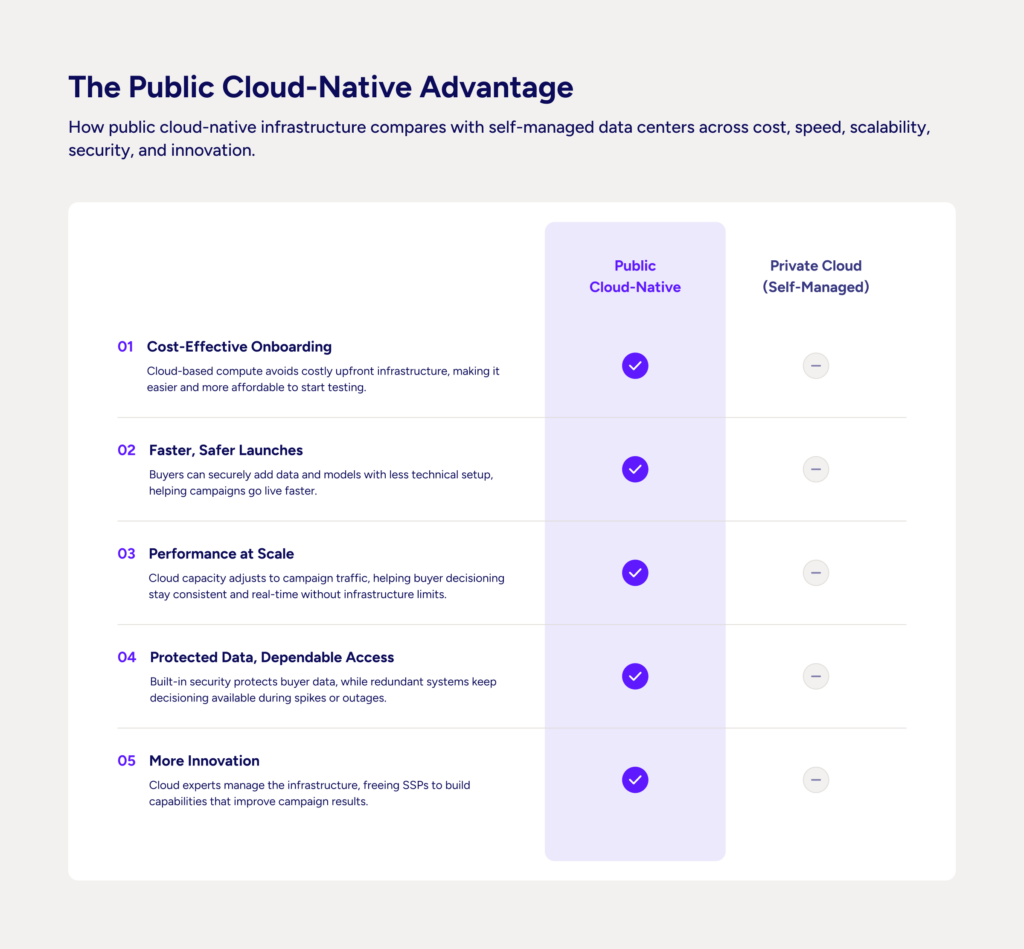
For buyers, that is the distinction that matters. The question is not simply where a platform runs, but whether its infrastructure can keep pace with the auction or becomes another constraint. A self-managed model requires more resources to maintain infrastructure; working with a cloud provider leaves more available for the speed, stability, and scale buyers expect from their adtech partners. That was a deliberate choice on our part: Value comes from building better adtech solutions, not from becoming better at running data centers.
Move the Logic, Not the Data
Running logic in containers is not a new capability for us. It is how we have run our own platform for years, and it is why we are good at operating containers on behalf of our partners.
The efficiency comes from a straightforward principle: It is better to execute logic where all of the data already is than to move a subset of that data out to wherever the logic happens to live. A model sitting outside the auction can only ever evaluate what fits in the request sent to it. A model running in the auction can see the full set of signals and influence a decision without data in the bidstream having to travel. The primary benefits are better performance at lower cost and lower latency.
Containerization enables buyers and partners to bring their models to the supply, where signal fidelity is at its strongest. And our cloud-native infrastructure enables faster onboarding, greater adaptability, and more efficient scaling. It’s a powerful combination.
What Seven Years of Cloud-Native Infrastructure Taught Us
When OpenX moved from physical servers to a fully cloud-based infrastructure seven years ago, that shift freed our engineers to spend less time maintaining hardware and more time building our products as well as other custom solutions. But the benefits extend well beyond engineering efficiency. Public cloud infrastructure also provides clear operational advantages to scalability, sustainability, and security.
Scale That Isn’t Tiered
OpenX supports 3 million QPS and beyond, giving partners the capacity to apply decisioning logic at scale without limits based on status or priority. Some platforms cap out at a fraction of that, often with a lower ceiling for standard partners and a slightly higher one for partners who qualify for preferred status.
In comparison, OpenX can expand capacity in minutes or deploy to a new region in 24 hours instead of months, without making that level of support contingent on partner size or status. That elasticity lets us give every partner the same white-glove treatment, instead of reserving speed and flexibility for a select few.
More Flexibility, Better Outcomes
Our infrastructure approach also gives us access to spot instances, elastic compute, and a wide range of hardware profiles, so we can match capacity to how a workload actually behaves instead of provisioning for peak once and living with (and paying for) that decision for years. That flexibility pays off in three distinct ways:
- Sustainability. Moving off our own hardware made OpenX the first company across advertising, media, or technology to achieve CarbonNeutral® certification and meet the Net-Zero Standard requirements. Different hardware profiles also let us match the workload to the most efficient equipment instead of retiring hardware on a fixed schedule. By keeping older machines in service where they still perform well, using ARM processors where they fit, and placing workloads near low-carbon power sources like hydropower when possible, we reduce unnecessary replacement and lower the environmental cost of running the platform.
- Security. A public cloud lives or dies by its ability to guarantee and manage security. As a result, public clouds provide excellent and holistic security controls that allow us to lock down roles and permissions consistently and systematically. This level of rigor is near impossible to achieve when managing a variety of hardware and software from different vendors with different permission models, particularly when it’s a fraction of someone’s fulltime job.
- Operational expertise. Seven years of running containerized workloads at real auction volume has given OpenX deep expertise in operating cloud-native infrastructure at scale. It shows up in reliability and in faster product development.
Cloud-Native Infrastructure Built for the Auction
Building and operating natively in the cloud is why we can scale faster, secure the platform more precisely, and bring new capabilities to market more quickly. One result of that decision is OpenXBuild: a software suite that lets buyers and partners run their own logic inside secure containers on OpenX’s cloud-native infrastructure, for faster audience matching, more actionable auction insights, and a cleaner signal path for effective bidstream shaping and filtering. That foundation gives us the scale and flexibility to keep building what comes next.
So there is a cost worth examining, but it is not a line item on a cloud bill. Buyers may never pay for it directly, but the cost of private cloud is evident in delayed integrations and the inability to fully scale, which is ultimately a missed opportunity to make every bid more precise and every media dollar work harder.
Frequently asked questions
Question:What is the “cloud tax” in programmatic advertising?
The “cloud tax” is the argument that running an SSP on a public cloud adds a hidden infrastructure cost that eventually reaches brands and agencies. OpenX’s position is that the larger cost sits in self-managed infrastructure: slower scaling, engineering time spent on hardware instead of product, and delayed integrations.
Question:Does running an SSP on public cloud add latency to the auction?
Not in OpenX’s architecture. Apart from the requests sent to bidders, every step of the ad request pipeline runs inside OpenX’s cloud-native environment under continuously monitored latency service level objectives (SLO), so partner logic executes within the auction instead of calling out to an external service.
Question:How does OpenXBuild use this infrastructure?
OpenXBuild lets buyers and partners run their own decisioning logic in secure containers inside OpenX’s cloud-native infrastructure, in approximately 5 milliseconds, so a model acts on the full set of auction signals without moving data out of the bidstream.